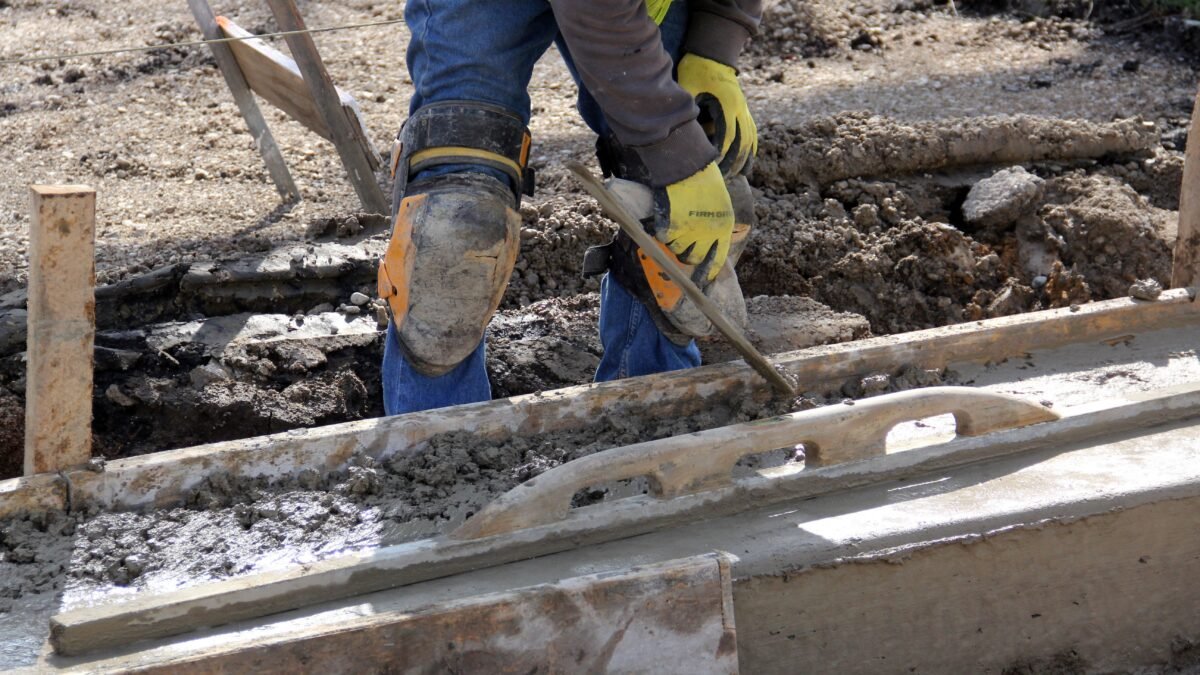
You can usually walk on new concrete after 24 to 48 hours, drive a car on it after 7 days, and it reaches its full design strength at about 28 days (ACI 308; Quikrete Concrete Mix data sheet). A fast-setting bagged mix is walkable in about 2 hours, while cold weather stretches every step. The first week matters most: keep the slab moist for 7 days, or it can end up much weaker than the mix was designed for.
Times and product data checked November 2026.
This guide covers drying vs curing, the walk, drive and full-strength timeline, set times for bagged mixes vs ready-mix, what speeds curing up or slows it down, how to cure a slab, cold and hot weather rules, and when it is safe to seal. We compared product data sheets from Quikrete and Sakrete with American Concrete Institute guidance (see our editorial policy: https://rooftoyard.com/editorial-policy/).
Safety first: Wet concrete can burn your skin. It is highly alkaline, with a pH of 12 to 13, and the burns often do not hurt until hours later. Wear waterproof, alkali-resistant gloves and tall waterproof boots, cover your arms and legs, and wash any concrete off your skin right away with clean, cool water.
Drying vs curing: two different clocks
Drying and curing are not the same thing, and mixing them up is how most new slabs get damaged. Drying is water leaving the slab. Curing is the chemical reaction between cement and water, called hydration, that builds strength. A slab can feel dry to the touch within hours and still be curing for weeks.
Curing needs water, so a slab that dries fast cures badly: when the surface runs out of water before the cement has finished reacting, it stays weak, dusts, and cracks. Fresh concrete is covered or misted so the water stays in for the first week.
Drying is the slower of the two: a rough rule of thumb is about 28 days of drying for every inch of slab thickness, so a 4-inch slab can take months to dry right through, long after it has reached full strength. A sealer needs a dry surface, not just a strong one.
How long does concrete take to dry and cure? The timeline
The times below are for a standard mix poured at about 70°F and kept moist. Cold weather, dry wind, and a wetter mix all shift them.
| Use | When | Strength by then | Source |
|---|---|---|---|
| Light foot traffic | 24 to 48 hours | About 15 to 25% of design strength | Sakrete data sheet (24 hours); MyConcreteCalc |
| Light loads (furniture, wheelbarrow, bikes) | 3 days | About 35 to 40% | Quikrete training (about 35% at 3 days); Quikrete 1101 data sheet |
| Cars and light pickups | 7 days | About 60 to 70% | ACI 308; Quikrete 1101 data sheet |
| Heavy trucks, RVs, dumpsters | 28 days | Full design strength | ACI 308; Quikrete 1101 data sheet |
| Full strength | 28 days | 100% of design strength | ACI 301; Quikrete and Sakrete data sheets |
Walk on it after 24 hours at the earliest, and 48 hours is the safer call on a driveway, where a footprint or a paw print is hard to fix. Slab edge forms can usually come off after about 2 days, but forms that carry weight stay in place for at least 7 days.
The 7-day mark is the big one for a driveway. By then the concrete has about 60 to 70% of its design strength, which is why the American Concrete Institute sets 7 days as the minimum curing period, or until the concrete reaches 70% of its specified strength. The 28-day mark is the testing standard engineers design to, not a switch: hydration keeps going slowly for months.
How concrete gains strength: the 28-day curve
Quikrete’s own data sheet for its standard Concrete Mix (No. 1101) shows the curve in psi, and the percentages are our math from those figures:
| Age | Strength (Quikrete 1101) | Share of 28-day strength |
|---|---|---|
| 1 day | 750 psi | 19% (750 / 4,000 = 19%) |
| 3 days | 1,500 psi | 38% (1,500 / 4,000 = 38%) |
| 7 days | 2,500 psi | 63% (2,500 / 4,000 = 63%) |
| 28 days | 4,000 psi | 100% |
Sakrete’s standard mix agrees: 2,500 psi at 3 days, 2,755 psi at 7 days, and 4,000 psi at 28 days. Two brands, same shape: fast gains in the first week, then a long, slow climb to full strength.
Strength gain of Quikrete Concrete Mix No. 1101
1 day: 750 psi
3 days: 1,500 psi
7 days: 2,500 psi
28 days: 4,000 psi
Scale: 0 to 4,000 psi. Source: Quikrete Concrete Mix No. 1101 data sheet.
Bagged concrete vs ready-mix: set times by product
Set is not cured. Set means the mix has gone firm and can no longer be worked; curing is the weeks-long strength gain that follows. Bagged mixes differ a lot in set time, so check the bag you bought.
| Mix | Set time | Walk on | 28-day strength | Source |
|---|---|---|---|---|
| Quikrete Concrete Mix No. 1101 (standard bagged) | A few hours (Quikrete does not publish a set time) | 24 to 48 hours | 4,000 psi | Quikrete data sheet |
| Quikrete Fast-Setting Concrete Mix No. 1004 | 20 to 40 minutes | 2 hours; heavy objects after 4 hours | 4,000 psi | Quikrete FAQ; data sheet |
| Quikrete 5000 No. 1007 (high early strength) | Sets quickly | 10 to 12 hours | 5,000 psi | Quikrete data sheet |
| Sakrete Concrete Mix (standard bagged) | About 6 hours | 24 hours | 4,000 psi | Sakrete data sheet |
| Sakrete 5000 Plus | Rapid setting | 12 hours; vehicles after 72 hours | 5,000 psi | Sakrete data sheet |
| Ready-mix, standard 3,000 to 4,000 psi | Initial set 2 to 4 hours; final set 4 to 8 hours at 70°F | 24 to 48 hours | 3,000 to 4,000 psi | ACI 308 guidance |
Fast-setting bagged mix is made for setting posts and small pours, not for a full driveway slab. Quikrete says it provides about 400 psi in 2 hours and is often used for setting air conditioner bases and other small projects around the house. For a driveway, use a standard mix or a high-early-strength mix such as Quikrete 5000 or Sakrete 5000 Plus.
The bag vs truck choice is about volume, not curing speed: a standard bagged mix and a standard ready-mix cure on the same timeline. Bags win on small jobs; past about 1 to 2 cubic yards a truck is usually cheaper and far less work. Our concrete calculator (https://rooftoyard.com/concrete-calculator/) works out the bags and the truck price for your size.
Quikrete does not publish a drive-on time for its Fast-Setting mix, so use the standard 7-day rule for cars unless the product sheet for the mix you bought says otherwise. Sakrete does publish one for its 5000 Plus: vehicles after 72 hours.
What speeds curing up or slows it down
Temperature matters most. The ideal range for curing concrete is 50°F to 90°F, and the timeline in this guide assumes about 70°F. Below 50°F, set and strength gain run at about half speed. Above 90°F the set speeds up, but the surface can dry out before it cures and crack. At 40°F, expect every milestone to take two to three times longer.
Humidity and wind come next. Dry air and wind pull water off the surface and stall curing, so the same pour cures differently on a calm, overcast day than on a hot, windy one.
Water in the mix is the hidden lever. More water makes concrete easier to place and weaker when cured. Quikrete’s training material puts numbers on it: 4 quarts of water per 80 lb bag of Concrete Mix gives 4,000 psi, while 5 quarts drops it to 2,500 psi. Never add extra water to make a stiff mix easier to work.
The mix type sets the pace. High-early-strength cement and mixes such as Quikrete 5000 gain strength faster, which is why they are used in cold weather. Mixes with fly ash or slag gain strength more slowly at first and catch up by 28 to 56 days. Thicker slabs hold moisture longer inside but take longer to dry right through.
Accelerators speed the set in cold weather. A calcium chloride accelerator at 1 to 2% by weight of cement is the common one.
How to cure concrete properly
Start curing after finishing, once the surface is firm enough that water will not mark it, usually a few hours after the pour. Keep the concrete moist for at least 7 days. That is the American Concrete Institute’s minimum for normal concrete at 50°F or above, and Quikrete says 5 days at 70°F or warmer and 7 days in cooler weather. Sakrete asks for at least 3 days damp on its standard mix.
Any of these methods works. Mist the surface with a hose a few times a day. Lay wet burlap or cotton mats on the slab and keep them wet. Pond water on a flat slab behind small dikes. Cover the slab with plastic sheeting, weighed down at the edges, and re-wet underneath if the surface starts to look dry. Or spray on a curing compound after finishing, which forms a thin film that holds moisture in.
It pays to do it right. American Concrete Institute guidance says proper curing can add up to about 50% to the concrete’s strength compared with concrete left to dry in the air. The most common mistake is letting the surface dry out between waterings: a dry covering draws moisture out of the concrete instead of adding it. The second is finishing too early or overworking the surface, which Sakrete warns causes dusting, cracking, scaling, and a weak surface.
Pouring in cold weather
Cold weather is the biggest risk to a new slab, because hydration slows sharply below 40°F and stops near freezing. The American Concrete Institute’s cold-weather guide (ACI 306R) says to keep fresh concrete at or above 50°F for the first 3 to 7 days, and to protect it from freezing until it reaches about 500 psi, which usually takes the first 24 to 48 hours.
At 40°F, plan on roughly double the normal times: walkable in 48 to 72 hours, cars in 14 to 21 days, and full strength in 45 to 60 days. Those are approximate figures from a curing guide based on ACI 306R, so treat them as planning numbers.
Never pour on frozen ground. Use insulating blankets over the slab, and heated enclosures below 40°F. Warm mixing water and an accelerator help, and Sakrete says to keep the mix and the ground between 40°F and 86°F for 24 hours before the pour and 48 hours after.
Pouring in hot weather
Hot weather flips the problem: the set speeds up, but the surface can dry out before it cures, which causes plastic shrinkage cracks. Pour early in the morning or late in the day, and set up shade and windbreaks. Mist the subgrade before the pour, without leaving puddles. Cure as soon as finishing allows, within the first hour if it is above 85°F, and keep the slab damp for 7 days. Cold mixing water slows the set, and a curing compound applied right after finishing holds the moisture in.
Rain is only a problem before the surface sets, roughly the first 4 to 8 hours: it washes out the paste and pits the finish, so cover the slab with plastic. Once the surface is hard, rain does no harm and helps curing.
When is it safe to seal new concrete?
Wait at least 28 days before a standard sealer. Most sealer manufacturers require 28 days, and sealing sooner traps moisture that the sealer needs to escape, which can turn the finish milky or make it peel. Cure-and-seal products are the exception: they go on soon after finishing, once the surface is hard, and cure and seal in one step.
Even at 28 days, the slab must be dry, not just strong. Check it with the plastic-sheet test (ASTM D4263): tape a 2 ft by 2 ft sheet of plastic tight to the concrete, leave it for 24 hours, and look for condensation underneath. If the sheet is wet, wait longer. Nebraska’s transportation department requires at least 7 days of curing before any sealant goes on.
Worked example: a driveway poured on a Monday
Say you pour a standard ready-mix driveway on Monday at 8 a.m., at 70°F, and keep it moist. Monday afternoon the concrete sets and the crew finishes it. Tuesday at 8 a.m. is 24 hours, the earliest you can walk on it carefully, and Wednesday is the safer call. Thursday, 3 days in, you can roll a wheelbarrow across it and set out patio furniture. The following Monday, 7 days after the pour, you can park the car on it. Four weeks later, 28 days after the pour, it is at full strength, so a heavy truck or an RV can use it, and that is also the earliest you should seal it.
Pour the same driveway at 45°F and the calendar stretches: walk on it after 48 to 72 hours, park the car after 14 to 21 days, and wait 45 to 60 days for full strength.
Common mistakes
Let it dry out in the first week, and it never reaches its design strength. Add extra water to make it easier to place, and you trade 4,000 psi for 2,500 psi. Pour on frozen ground, and the slab can lose strength it never gets back.
Related guides: our concrete calculator (https://rooftoyard.com/concrete-calculator/), our concrete driveway cost guide (https://rooftoyard.com/concrete-driveway-cost/), and our guide to how much it costs to pave a driveway (https://rooftoyard.com/cost-to-pave-a-driveway/).
Common questions
How long does concrete take to cure?
About 28 days to full design strength, with about 60 to 70% of that strength reached in the first 7 days (ACI 308; Quikrete Concrete Mix No. 1101 data sheet).
How fast does concrete dry?
The surface can feel dry within hours, but drying and curing are different: curing is the chemical reaction that builds strength over about 28 days, and a slab can take weeks or months to dry all the way through.
How long before you can drive on new concrete?
Wait 7 days for a car on a standard mix poured at mild temperatures (ACI 308; Quikrete and Sakrete data sheets). Heavy trucks, RVs, and dumpsters should wait the full 28 days.
How long before you can walk on new concrete?
After 24 to 48 hours for a standard mix (Sakrete data sheet; ACI 308 guidance). A fast-setting bagged mix can be walked on after about 2 hours (Quikrete).
How long for a concrete driveway to cure?
The same as any slab: walk on it in 24 to 48 hours, drive on it in 7 days, and full strength in 28 days. Our concrete driveway cost guide uses the same rule: about a week before driving, full strength in 28 to 30 days.
How long before dogs can walk on concrete?
Use the same 24 to 48 hour rule as for people. Keep pets off before that: wet concrete can burn their paws, and paw prints mark a fresh surface.
Sources
- Quikrete: Division 3 product line cards (Concrete Mix No. 1101, FastSet No. 1004-51, Quikrete 5000 No. 1007) (accessed November 2026)
- Quikrete: Frequently Asked Questions (accessed November 2026)
- Quikrete: Mixing & Placing Concrete & Cement Mixes, training (accessed November 2026)
- Quikrete: Concrete & Mortar Mix Ingredients, training (accessed November 2026)
- Sakrete (King Packaged Materials): Sakrete Concrete Mix technical data sheet (accessed November 2026)
- Sakrete (TCC Materials): Sakrete 5000 Plus High Strength Concrete Mix technical data sheet (accessed November 2026)
- Sakrete Canada: Sakrete Concrete Mix product page (accessed November 2026)
- CraftedCalcs: How Long Does Concrete Take to Cure? Complete Timeline (accessed November 2026)
- Renovimo: How Long Does Concrete Take to Dry and Cure? (accessed November 2026)
- MyConcreteCalc: How Long Does Concrete Take to Cure? (accessed November 2026)
- Metal America Concrete: Concrete Curing Time by Temperature and Complete Chart (accessed November 2026)
- Intermountain Concrete Specialties: All About Concrete Curing (ACI 308) (accessed November 2026)
- National Precast Concrete Association: Cement Burns (accessed November 2026)
- EngineerFix: How Long Should You Wait Before Sealing Concrete? (accessed November 2026)
- Nebraska Department of Transportation: Division 600 Portland Cement Concrete Pavement (accessed November 2026)
- Calendar UK: What is the minimum curing period of concrete? (accessed November 2026)