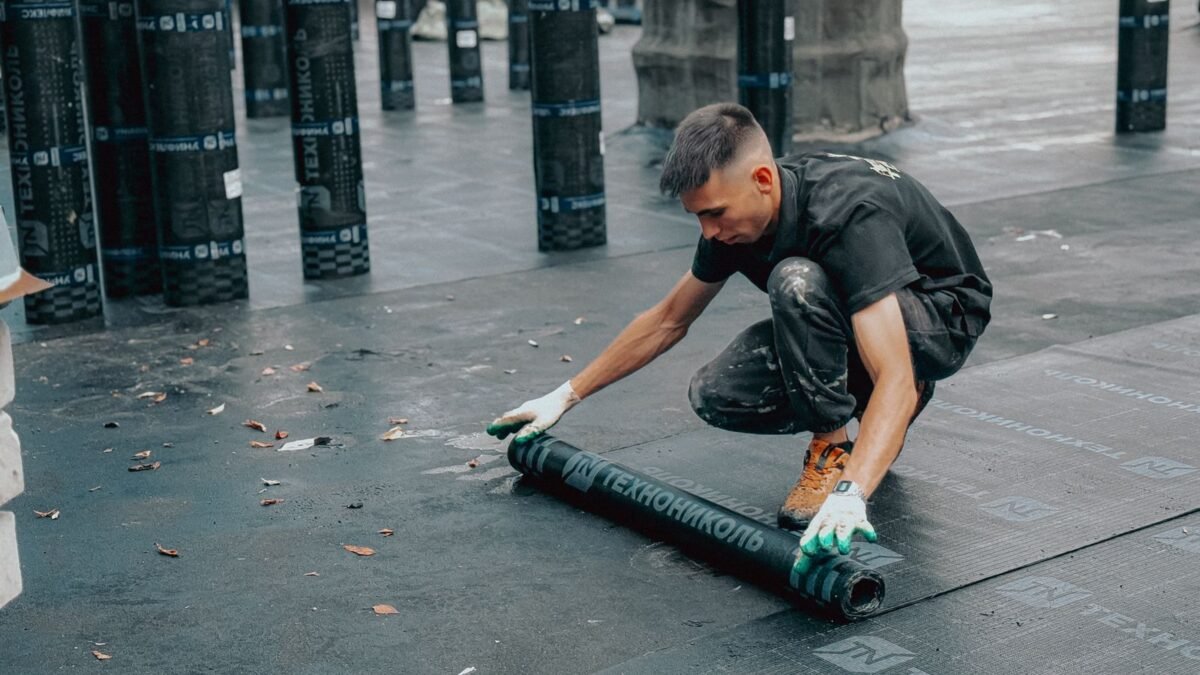
A built-up roof (BUR) costs about $3.50 to $10 per square foot installed in 2026, or $350 to $1,000 per roofing square of 100 sq ft. HomeGuide puts it at $3.50 to $7.50 (November 2025), Angi and Fixr at $4 to $10 (July and January 2026), and This Old House at $7 to $9 (March 2026). On a 1,000 sq ft flat roof that is $3,500 to $10,000, plus $1,000 to $2,000 to tear off the old roof at HomeGuide’s $1 to $2 per sq ft. HomeGuide, Angi and This Old House give BUR 20 to 30 years of life.
Prices updated October 2026.
This guide is for homeowners with a flat or low-slope roof: what a BUR is, what it costs, how long it lasts, and how it compares with modified bitumen, TPO and EPDM. We compared five cost guides and checked the details with GAF, ARMA, NRCA and NIOSH (see our editorial policy).
What is a built-up roof?
A built-up roof is a waterproof skin made on the roof from layers of bitumen (asphalt or coal tar pitch) and reinforcing felt. Each felt layer is called a ply. The top gets gravel set in a thick pour of bitumen, called a flood coat, or a cap sheet with a mineral surface. With gravel on top it is often called a tar-and-gravel roof (This Old House).
- Deck and insulation. Houses almost always have a wood deck (Journal of Light Construction, or JLC, 2005). GAF says the base sheet often sits on polyiso foam boards or a cover board.
- Base sheet and plies. Felts soaked in hot asphalt or cold adhesive go over the base sheet: two or three in JLC’s example, four in a 280-mil roof in NRCA’s Professional Roofing (2006), against 60 mils or less for most single-ply sheets.
- Surfacing. Gravel, a mineral cap sheet or a reflective coating. Gravel shields the asphalt from sun and adds fire and impact protection (JLC).
Hot or cold, asphalt or coal tar
The classic method is hot: asphalt is melted in a kettle (a heated tank) and mopped between plies at about 410°F in JLC’s example. GAF says torch-applied, cold-applied and self-adhered versions also exist. Coal tar pitch, the other bitumen, suits flatter roofs: the residential code (R905.9.1, as adopted in the 2025 California Residential Code) requires a slope of at least 1/4 inch per foot for built-up roofs but only 1/8 inch for coal-tar ones.
Built-up roof cost
Roofers price flat roofs per square foot or per square (100 sq ft). Installed BUR prices by guide:
| Source (page date) | Per sq ft | Per square |
|---|---|---|
| HomeGuide (November 2025) | $3.50 to $7.50 | $350 to $750 |
| Angi (July 2026) | $4 to $10 | $400 to $1,000 |
| Fixr (January 2026) | $4 to $10 | $400 to $1,000 |
| This Old House (March 2026) | $7 to $9 | $700 to $900 |
| Forbes Home (June 2024) | $4 to $10 | $400 to $1,000 |
HomeGuide’s typical BUR job is $4,500 to $12,600; This Old House puts BUR on a 2,000 sq ft home at $14,158 to $18,911. Labor is a big share: HomeGuide prices flat-roof labor at $2 to $4.50 per sq ft, Fixr at $3 to $7. Fixr calls BUR labor-intensive, and GAF says a job can take four days or longer.
Totals by roof size
Roof area times each guide’s rate. The last column adds HomeGuide’s tear-off ($1 to $2 per sq ft, disposal included) to its BUR price, $4.50 to $9.50 per sq ft in all.
| Roof area | HomeGuide ($3.50 to $7.50) | Angi, Fixr ($4 to $10) | HomeGuide with tear-off | Source |
|---|---|---|---|---|
| 500 sq ft | $1,750 to $3,750 | $2,000 to $5,000 | $2,250 to $4,750 | Guide rates |
| 1,000 sq ft | $3,500 to $7,500 | $4,000 to $10,000 | $4,500 to $9,500 | Guide rates |
| 1,500 sq ft | $5,250 to $11,250 | $6,000 to $15,000 | $6,750 to $14,250 | Guide rates |
| 2,000 sq ft | $7,000 to $15,000 | $8,000 to $20,000 | $9,000 to $19,000 | Guide rates |
Example: 1,500 sq ft × $3.50 = $5,250. Angi and Fixr price tear-off higher, at $1 to $5 per sq ft.
Worked example: new BUR on a 1,000 sq ft flat roof
One worn-out layer comes off, the new BUR goes on, and the roofer replaces a drain and the flashing (the strips that seal edges, walls and pipes). At HomeGuide’s prices:
| Line item | Math | Low | High | Source |
|---|---|---|---|---|
| Tear-off and disposal | 1,000 sq ft × $1 to $2 | $1,000 | $2,000 | HomeGuide |
| Built-up roof, installed | 1,000 sq ft × $3.50 to $7.50 | $3,500 | $7,500 | HomeGuide |
| Replace one roof drain | One drain | $70 | $340 | HomeGuide |
| Replace all flashing | Whole roof | $400 | $1,000 | HomeGuide |
| Permit | Flat fee | $150 | $500 | HomeGuide |
| Total | $5,120 | $11,340 |
With Angi’s BUR price of $4 to $10 per sq ft in place of HomeGuide’s (other lines unchanged), the total is $5,620 to $13,840. This Old House suggests holding 10% to 15% for surprises such as unexpected repairs: $512 (10% of $5,120) to $1,701 (15% of $11,340).
Related calculator: Our roof replacement cost calculator covers shingles, metal, wood, composite, tile and slate, not flat-roof membranes such as BUR, TPO, EPDM or modified bitumen. Use it for pitched sections and the tables above for the flat part.
BUR vs modified bitumen vs TPO vs EPDM
Modified bitumen is asphalt with rubber or plastic added, sold in rolls. TPO is a single-ply plastic sheet; EPDM is a single-ply synthetic rubber sheet. Installed prices per sq ft:
| Source | BUR | Modified bitumen | TPO | EPDM |
|---|---|---|---|---|
| HomeGuide (November 2025) | $3.50 to $7.50 | $4 to $7.50 | $4 to $10 | $3.50 to $10 |
| Angi (July 2026) | $4 to $10 | $4 to $8 | $4 to $14 | $5 to $13 |
| Fixr (January 2026) | $4 to $10 | $4 to $8 | $4 to $14 | $4 to $13 |
| This Old House (March 2026) | $7 to $9 | $7 to $9 | $8 to $11 | $9 to $13 |
Flat roofs: installed cost per square foot (Angi)
Modified bitumen: $4 to $8
Built-up (BUR): $4 to $10
EPDM rubber: $5 to $13
TPO: $4 to $14
Scale: $0 to $15 per sq ft. Source: Angi flat roof guides (updated July 2026, accessed October 2026).
| Material | How it goes on | Lifespan (years) | Method source |
|---|---|---|---|
| BUR | Bitumen mopped between felt plies, gravel or cap sheet on top | 20 to 30 (HomeGuide, This Old House); 15 to 30 (Fixr); 30 (Angi, InterNACHI) | GAF |
| Modified bitumen | Rolls torched, hot-mopped, glued cold or peel-and-stick | 10 to 20 (HomeGuide, Angi); 20 (Fixr, InterNACHI); 20 to 30 (This Old House) | This Old House, Angi |
| TPO | Single sheet, seams heat-welded | 10 to 25 (HomeGuide); 15 to 20 (Angi); 20 to 30 (Fixr); 7 to 20 (InterNACHI) | Angi |
| EPDM | Large rubber sheets glued or fastened | 15 to 25 (HomeGuide, InterNACHI); 10 to 25 (Angi cost guide); up to 30 (Fixr); 25 to 30 (Angi materials guide) | Angi |
Built-up roof vs modified bitumen
Both are asphalt based, and This Old House prices both at $7 to $9 per sq ft with 20 to 30 years of life. It says modified bitumen is easier to install and flexes with temperature swings, though torch-down work is a fire risk if done carelessly. BUR’s strength is its stack of plies, which keeps protecting the roof if the top is damaged (GAF).
Pros and cons of a built-up roof
- Pro: backup layers. Lower plies keep water out if the top is damaged (GAF, ARMA).
- Pro: fire and foot traffic. ARMA says many systems meet UL Class A fire ratings; GAF says BUR handles foot traffic and temperature swings.
- Pro: easy patching and a mid-range price. Fixr calls BUR very easy to repair. In every guide above, BUR tops out below TPO and EPDM.
- Con: weight. JLC puts tar and gravel at about 450 lb per square (4.5 lb per sq ft) and a cap-sheet BUR at about 220 lb. This Old House says it may need added structural support.
- Con: messy install, hidden leaks. This Old House warns of strong odors from heated asphalt and says leaks are harder to locate under several layers.
- Con: hot surface. Professional Roofing (2006) put uncoated smooth BUR at about 5% solar reflectance, against about 70% with a white coating.
Lifespan and maintenance
Plan on about 20 to 30 years, as the table above shows; This Old House’s cost guide is lower, at 10 to 20. Professional Roofing said a well-kept hot-mopped BUR often lasts 20 years or more (2006), and GAF says manufacturer guarantees run up to 20 years. Our guide to how long a roof lasts covers other types.
ARMA recommends a yearly check for clogged drains, pitch pockets (sealant-filled collars around pipes and posts) that need topping up, and damage left by other trades. Common problems:
| Problem | What it means | Repair cost | Source |
|---|---|---|---|
| Ponding water | Standing water, often from a clogged drain, sometimes a sagging deck | $70 to $750 | Fixr |
| Blisters | Air or moisture trapped between layers | $250 to $1,500 | Fixr |
| Flashing failure | Seals at walls, edges or pipes letting go | $200 to $750 | Fixr |
| Leak | Water getting inside | $150 to $4,000 | Fixr |
| Worn surface | Worn coating, or bare spots where gravel is gone | Recoating $1 to $4 per sq ft | HomeGuide |
Fixr prices BUR repairs at $3 to $7 per sq ft, with small patches from $150. Very high winds can scour gravel off (Professional Roofing); ARMA says smooth roofs can be resurfaced with a flood coat, a coating, or asphalt and gravel.
Who a built-up roof suits
BUR fits a flat or very low-slope roof that gets walked on, or an owner who wants layered protection, if the framing can carry it. Pick something else when:
- The structure is light. EPDM is light and rarely needs reinforcement (This Old House).
- Summers are hot. White TPO reflects sunlight (Angi); a BUR needs a white cap sheet or coating to match (GAF, ARMA).
- You will be home during the work. Ask for a cold-applied or self-adhered system, or choose a single-ply sheet, to avoid hot asphalt.
- You want a longer life. Angi lists standing seam metal among flat-roof options at $3.25 to $14.25 per sq ft, lasting 40 to 70 years; see our metal roof cost guide.
Roofing over an old BUR? This Old House says most codes allow two layers, then a full tear-off; our new roof permit guide covers permits.
Fumes and safety during a hot install
NIOSH’s guide for roofers (2003) lists headache, nausea and eye, nose, throat and skin irritation from asphalt fumes, which it calls mild and short-lived. It adds that some studies find a higher lung cancer risk in roofers, but researchers are not sure whether asphalt fumes or other causes, such as smoking, coal tar or asbestos, are to blame. NIOSH tells crews to open kettle lids as little as possible and to consider fume-suppressing asphalt; ARMA says cold application cuts fumes. Before work starts:
- Ask where the kettle will sit. NIOSH says firm, level ground with an ABC fire extinguisher close by.
- Ask about fume-suppressing asphalt or a cold-applied system.
- Keep people and pets away from the roof edge; JLC says no one should work below an active hot-mop crew.
Browse our other roofing cost guides.
Common questions
What is a built-up roof?
A flat-roof covering built on site from layers of asphalt or coal tar and felt, topped with gravel or a mineral cap sheet. With gravel it is often called a tar-and-gravel roof (This Old House).
How much does a built-up roof cost?
HomeGuide says $3.50 to $7.50 per square foot installed; Angi and Fixr say $4 to $10. A 1,000 sq ft roof is $3,500 to $10,000, plus $1,000 to $2,000 for tear-off (HomeGuide).
How long does a built-up roof last?
Usually 20 to 30 years (HomeGuide, This Old House). Fixr says 15 to 30 with good maintenance; Angi and InterNACHI say 30.
Is a built-up roof better than modified bitumen?
Not clearly. This Old House prices both at $7 to $9 per sq ft with 20 to 30 years of life. Modified bitumen is easier to install (This Old House); BUR’s extra plies keep protecting the roof if the top layer is damaged (GAF).
Is a tar and gravel roof the same as a built-up roof?
Yes, it is a built-up roof with a gravel surface. A BUR can instead be finished with a mineral cap sheet or a coating (GAF, ARMA).
Can you put a new flat roof over an old built-up roof?
Usually once. This Old House says most codes allow two roof layers, then a full tear-off. Tar and gravel already weighs about 450 lb per square (JLC), so check the structure.
Sources
- HomeGuide: How Much Does a Flat Roof Replacement Cost? (2026) (accessed October 2026)
- Angi: How Much Does Flat Roof Replacement Cost? [2026 Data] (accessed October 2026)
- Angi: Flat Roofing Materials: 6 Options to Consider For Your Home (accessed October 2026)
- Fixr: How Much Does a Flat Roof Replacement Cost? (accessed October 2026)
- Fixr: Flat Roof Repair Cost (accessed October 2026)
- This Old House: How Much Does Flat Roof Replacement Cost? (accessed October 2026)
- This Old House: 3 Types of Flat Roofs: Pros and Cons (accessed October 2026)
- Forbes Home: Flat Roof Replacement Cost (accessed October 2026)
- GAF: What Is Built-Up Roofing? (accessed October 2026)
- Asphalt Roofing Manufacturers Association: BUR Multi-Ply Built-Up Roofing (accessed October 2026)
- NRCA Professional Roofing: Assessing asphalt (November 2006) (accessed October 2026)
- Journal of Light Construction: Built-Up Hot-Mop Roofing (February 2005) (accessed October 2026)
- NIOSH: Reducing Roofers’ Exposure to Asphalt Fumes (Publication 2003-107) (accessed October 2026)
- 2025 California Residential Code: Section R905, Requirements for Roof Coverings (accessed October 2026)
- InterNACHI: Standard Estimated Life Expectancy Chart for Homes (accessed October 2026)