Replacing garage door springs usually costs $150 to $350 for a standard door, with extension springs at the low end and torsion springs at the high end. Full-service companies and heavy two-car doors often charge $350 to $750 or more. If your door has two springs, replace both at the same visit.
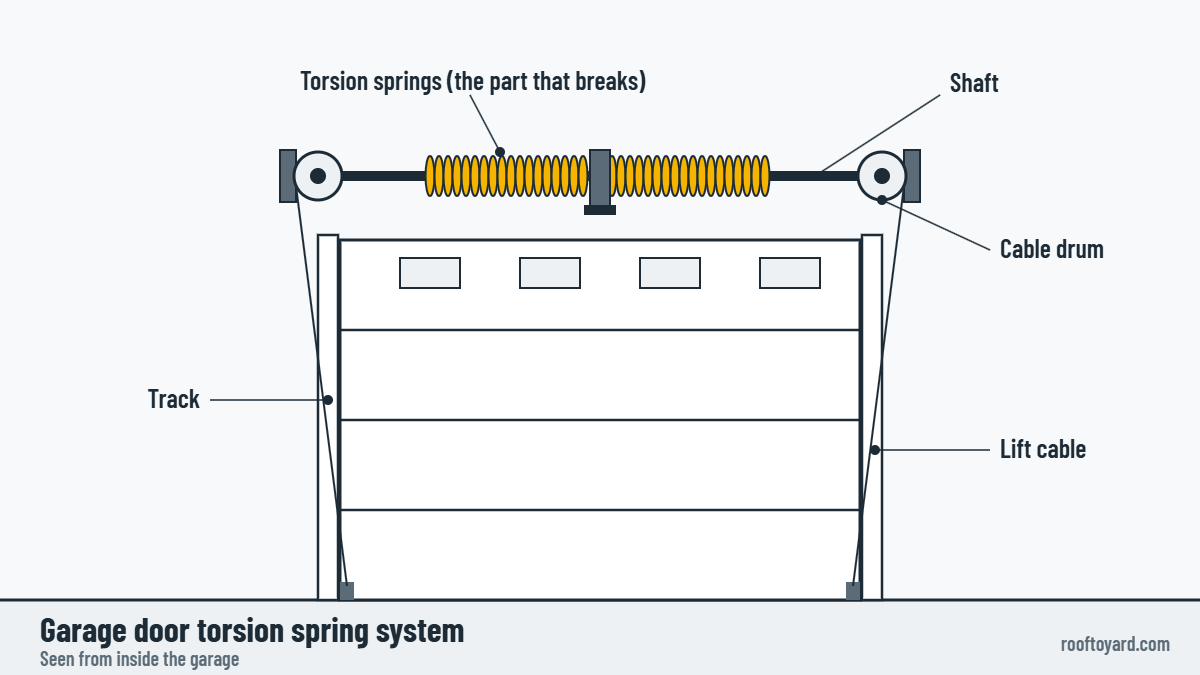
Garage door springs do the heavy lifting. The opener only guides the door; the springs carry most of its weight. When one breaks, the door suddenly feels like it weighs a few hundred pounds, and most doors won’t open at all.
This guide covers what a spring job costs in 2026, what you’re actually paying for, why some quotes come in at $750 or more, how to tell which spring you have, and what to ask before you let anyone start work.
Garage door spring replacement cost at a glance
| Job | Typical cost, installed |
|---|---|
| Extension springs | $120 to $200 |
| Torsion springs | $150 to $350 |
| Torsion springs plus a new shaft (bar) | $200 to $400 |
| Springs plus new lift cables | $200 to $500 |
| Convert extension springs to torsion | $400 to $800 |
| Full-service company, one spring | $350 to $750 |
| Full-service company, a pair | $500 to $1,500 |
Why such a wide range? Independent repair techs and big full-service companies price very differently, and extras like cables, rollers or an emergency visit add up fast. The spring itself is a small part of the bill; most of what you pay is labor and the service call.
What you’re paying for: parts, labor and the service call
Most cost guides give you one total and stop there. Here is how a spring bill usually breaks down, so you can see which line is driving your quote.
| Line on the bill | Typical cost | What it covers |
|---|---|---|
| Torsion spring (part) | $75 to $150 each | A standard spring rated for about 10,000 cycles |
| Extension spring (part) | $50 to $100 each | Usually sold and replaced as a pair |
| Labor | $75 to $150 | Removing the old spring, installing and winding the new one, balancing the door |
| Service call or diagnostic fee | $75 to $150 | The trip to your house. Some companies credit it toward the repair; ask first. |
| Second spring, same visit | About $100 to $150 more | The part plus a little extra labor, since the tech is already there |
| High-cycle upgrade | About $100 to $200 more | Springs rated for 25,000 cycles or more |
| Emergency trip fee | $100 to $200 | Nights, weekends or same-day service, where charged |
Notice that the spring itself is often less than half the bill. That’s why a cheap spring you find online doesn’t save much: the labor, the trip and the risk are what you’re really paying a pro for.
Why some quotes are $500 to $1,500
If one company says $250 and another says $750 for the same broken spring, they usually aren’t quoting the same job. Here is an example of two quotes for the same two-spring door, line by line.
| Line | Quote A: $250 | Quote B: $750 |
|---|---|---|
| Springs | 1 standard spring, $90 | 2 high-cycle springs, $300 |
| Labor | $110 | $150 |
| Service call | $50 | $150 emergency trip fee |
| Extras | None | New rollers $100, new cables $50 |
| Total | $250 | $750 |
Quote A only fixes the spring that broke. Quote B replaces both springs with longer-lasting ones, adds an emergency fee and swaps parts that may or may not be worn. Neither quote is automatically wrong. The question is which lines you actually need.
High-cycle springs
High-cycle springs usually add $100 to $200 to the job. They’re worth it if you open the door four or more times a day, and often not if you use it once or twice. The cost-per-year math is in the lifespan section below.
The “replace both springs” rule
This one is a fair charge. On a two-spring door, both springs have done the same number of cycles, so the second one is close to breaking too. Doing both now adds about $100 to $150; doing it later means paying for a second service call.
Upsell red flags
- A very low advertised price that turns into a much bigger bill once the tech arrives. The ad price often covers only the trip.
- New rollers, cables or an opener “while we’re here” without showing you the worn part. Ask to see it.
- Pressure to replace the whole door for a broken spring. A spring job is a repair, not a reason for a new door.
- No written price before work starts. A fair company tells you the total first.
Torsion vs extension springs: which one do you have?
Stand inside the garage with the door closed and look up.
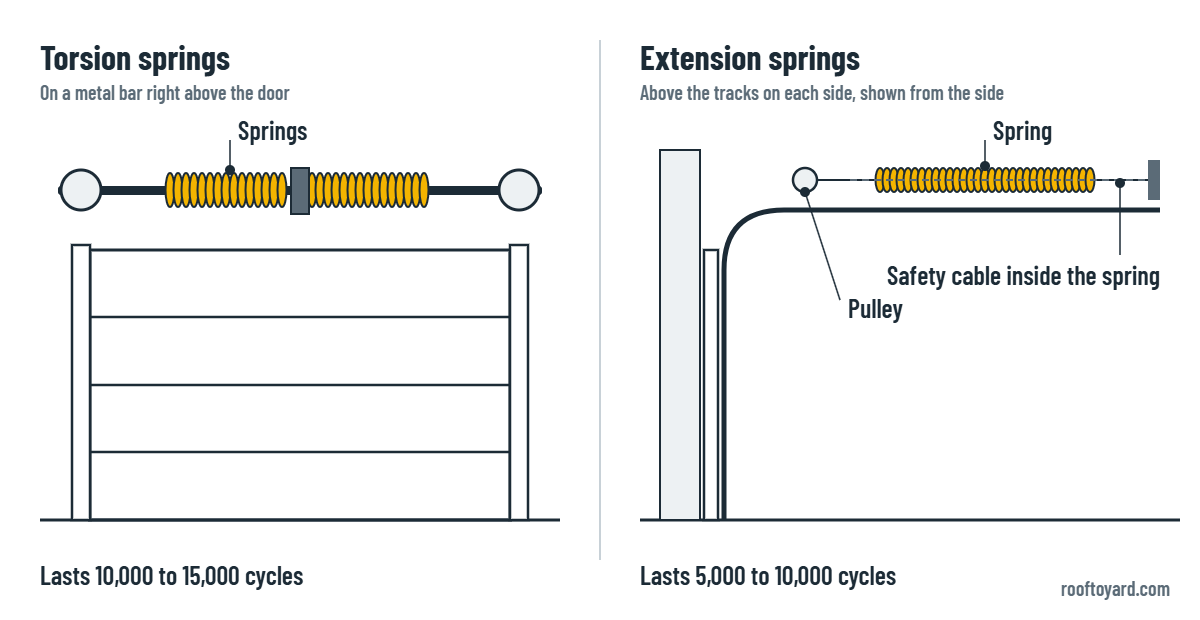
- Torsion springs sit on a metal shaft on the wall right above the door. Most modern roll-up doors use them.
- Extension springs run along the horizontal tracks on each side of the door and stretch as the door closes. You’ll find them on older and lighter doors.
| Torsion springs | Extension springs | |
|---|---|---|
| Where they are | On a shaft above the door | Along the side tracks |
| Typical rating | 10,000 to 15,000 cycles | 5,000 to 10,000 cycles |
| Cost to replace | $150 to $350 | $120 to $200 |
| Good to know | Smoother, quieter, balance the door better | Need safety cables through the middle so a broken spring can’t fly loose |
If you have extension springs and they break, ask about converting to torsion at the same visit. It costs more up front, about $400 to $800, but the door runs smoother and the springs last longer.
How to identify your spring before you call
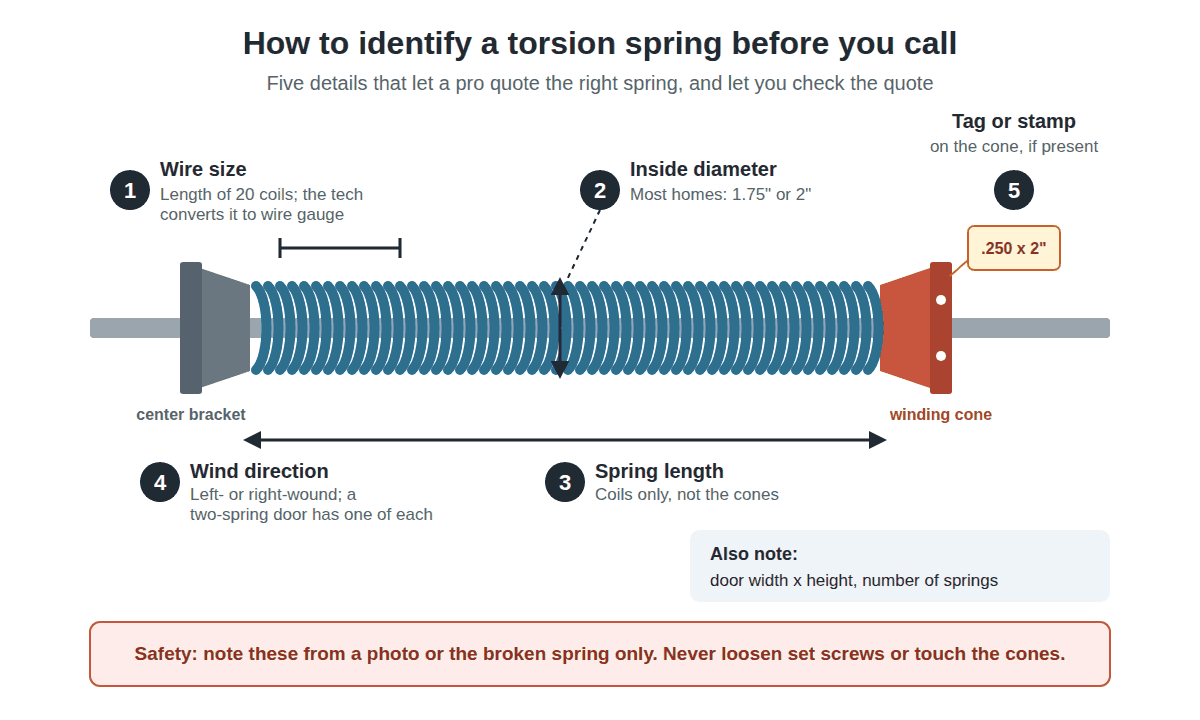
Springs are sized to your door’s weight, so a good tech needs a few details. If you can give them on the phone, you’ll get a firmer quote and it’s easier to spot a price that’s padded. Take a photo from a safe distance, or look at the broken spring, and note:
- Wire size. Measure the length of 20 coils on the broken spring. The tech converts that to a wire gauge.
- Inside diameter. Most home doors use 1.75-inch or 2-inch springs.
- Spring length. The coiled part only, not the cones at the ends.
- Wind direction. Springs are left- or right-wound. A two-spring door has one of each.
- Any tag or stamp on the cone, plus your door’s width, height and number of springs.
How long do garage door springs last?
Springs aren’t rated in years. They’re rated in cycles, and one cycle is the door opening once and closing once. Most standard springs are rated for about 10,000 cycles. So how long yours last depends almost entirely on how often you use the door.
| Door opens and closes | A 10,000-cycle spring lasts about |
|---|---|
| 2 times a day | 13 years |
| 4 times a day | 7 years |
| 6 times a day | 4.5 years |
| 10 times a day | Under 3 years |
Are high-cycle springs worth it? The cost-per-year math
High-cycle springs cost more up front but last much longer. Here is an example with a pair of standard springs at $350 installed (10,000 cycles) and a pair of high-cycle springs at $500 installed (30,000 cycles):
| Door use | Standard pair, $350 | High-cycle pair, $500 |
|---|---|---|
| 2 cycles a day | Lasts ~13.7 years, about $26 a year | Lasts ~41 years, about $12 a year |
| 4 cycles a day | Lasts ~6.8 years, about $51 a year | Lasts ~20.5 years, about $24 a year |
| 6 cycles a day | Lasts ~4.6 years, about $77 a year | Lasts ~13.7 years, about $36 a year |
Worked example: A family uses the garage as its main door, about 4 cycles a day, or 1,460 a year. Standard springs last 10,000 ÷ 1,460 = 6.8 years, so $350 ÷ 6.8 = about $51 a year. High-cycle springs last 30,000 ÷ 1,460 = 20.5 years, so $500 ÷ 20.5 = about $24 a year. For this family, the extra $150 pays for itself and saves at least one future service call.
If you use the door once or twice a day, or you plan to move within a few years, standard springs are usually fine. If the garage is your family’s main way in and out, high-cycle springs are the better buy.
Signs a spring is broken or about to go
- A loud bang from the garage when nobody was using the door. That’s usually a torsion spring snapping.
- A gap in the coil. A healthy torsion spring is one tight coil. A 2-inch gap means it has broken.
- The door is very heavy by hand, or the opener strains and lifts it only a few inches.
- The door hangs crooked or closes faster than it used to.
- Squeaking, stretching or rust on older springs, which often means they’re near the end.
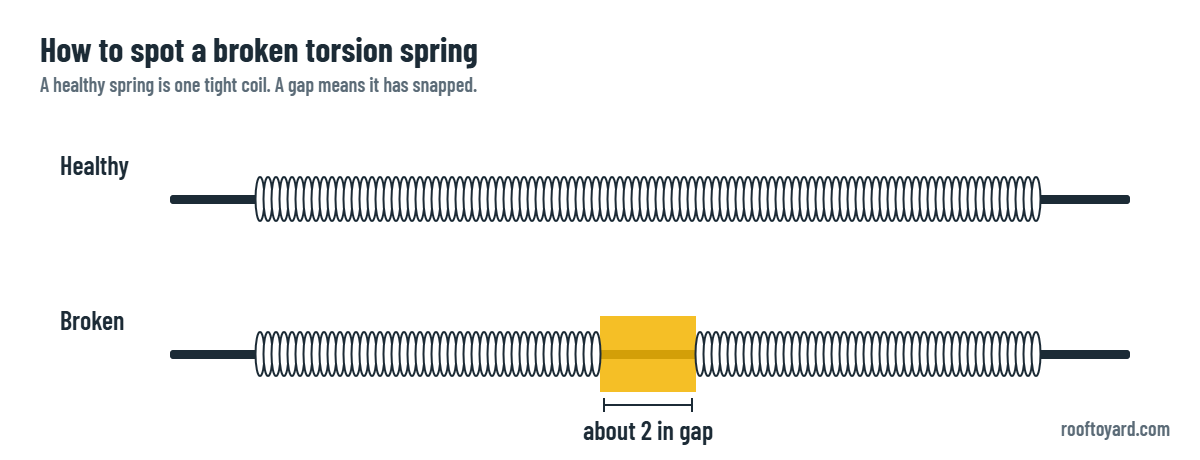
If a spring has broken, stop using the opener. Forcing a heavy door up can burn out the opener motor, and a door without spring support can fall fast.
Replace one spring or both?
Replace both. Springs on the same door are the same age and have done the same number of cycles, so when one breaks the other usually isn’t far behind. A matched new pair also keeps the door balanced. Doing both at once costs a little more in parts but saves you a second service call a few months later.
Can you replace a garage door spring yourself?
We don’t recommend it. A wound torsion spring holds enough force to lift a door that weighs a couple hundred pounds, and releasing it the wrong way can break bones. Garage doors cause about 30,000 injuries a year in the U.S., based on Consumer Product Safety Commission figures cited by the industry. Spring work needs the right winding bars, the right spring size for your door’s weight, and experience. For a job that costs a few hundred dollars, a pro is worth it.
What else can raise the bill
- Door size and weight. Two-car, insulated and wood doors need heavier, pricier springs.
- Worn parts. Frayed cables, bad rollers or worn bearings found during the visit are extra.
- Emergency calls. Nights, weekends and same-day service often add a trip fee.
- Where you live. Labor costs more in big cities than in rural areas.
How to save and get a fair quote
- Ask for one total price for both springs, parts and labor, before any work starts.
- Ask whether the service call fee is credited toward the repair.
- Ask what cycle rating the new springs have and what the warranty covers.
- If your car isn’t trapped, skip the emergency fee and book a regular weekday visit.
- Be careful with very cheap ads. A low advertised price often covers only the service call.
- If it isn’t an emergency, get two or three quotes, and give each company the same spring details from the list above.
Common questions
How much does it cost to replace a torsion spring?
Usually $150 to $350 installed. Heavier two-car doors and full-service companies can run $350 or more for a single spring.
Why did I get a quote of $750 or more for a spring?
High quotes usually bundle several things: both springs instead of one, high-cycle springs, an emergency trip fee and extra parts like rollers or cables. Ask for a line-by-line price and decide which items you actually need.
Are high-cycle garage door springs worth it?
Yes, if you open the door four or more times a day. At that use, a high-cycle pair costs about half as much per year as standard springs. For light use, standard springs are usually fine.
Can I open my garage door with a broken spring?
It’s risky. Without the spring, you’re lifting the full weight of the door, and it can drop suddenly. Don’t use the opener either. If you must get a car out, call a pro; many offer same-day service.
Does homeowners insurance cover a broken garage door spring?
Usually not. Springs wear out with normal use, and standard homeowners policies don’t pay for wear and tear. Damage from a covered event, such as a car hitting the door, is a different story, so check your policy.
How many springs does a garage door have?
Extension systems always use two, one on each side. Torsion systems use one or two; wider and heavier doors usually have two.
Sources
- HomeGuide: garage door spring replacement cost
- Angi: garage door spring replacement cost, 2026
- This Old House: garage door spring cost, 2026
- ConsumerAffairs: cost to replace a garage door spring
- A1 Garage Door Service: spring replacement price guide, 2026
- A1 Garage Door Service: emergency garage door repair cost, 2026
- Garage Door Science: garage door repair cost, 2026
- Learn Garage Doors: are high-cycle springs worth the price?
- Raynor: garage door spring types and lifespan
More guides in Garage Doors. Want a price for your own project? Try our cost calculators.