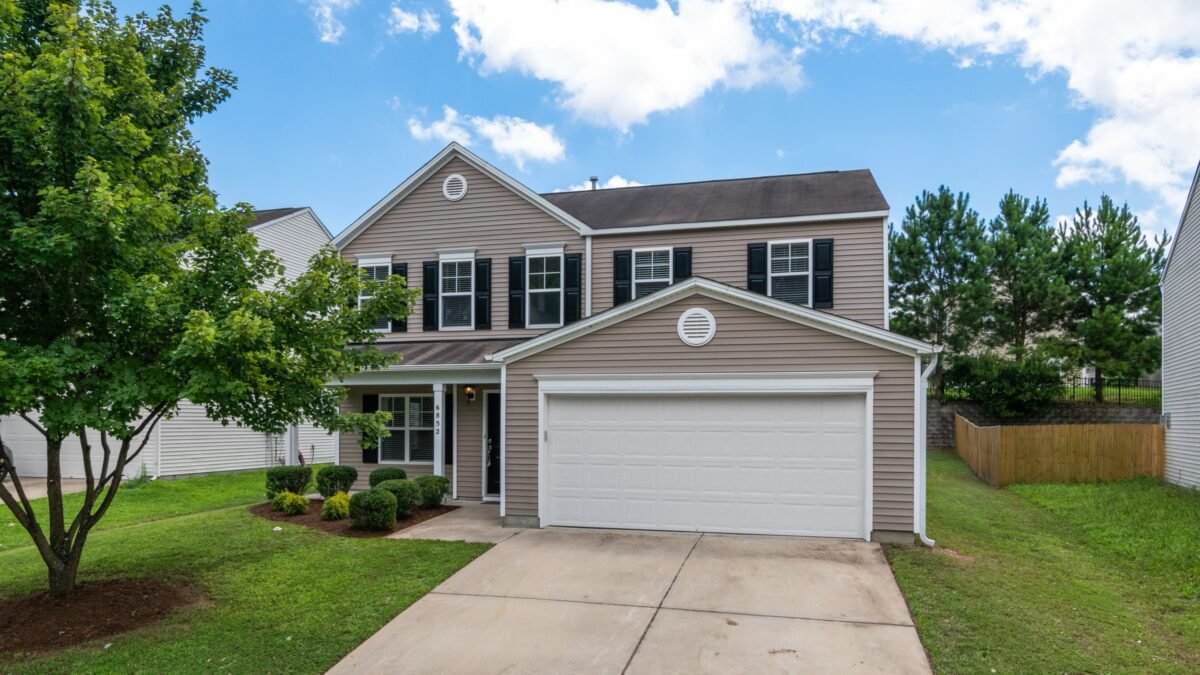
Most single garage doors are 8 or 9 ft wide by 7 ft high, and most double doors are 16 ft wide by 7 ft high (Clopay, November 2026). A single door costs $700 to $2,700 installed, and a double door costs $1,000 to $3,500 installed (HomeGuide, July 2025). Standard sizes are the cheapest to buy because makers stock them, so measure your opening first and order the standard size that fits.
Prices updated November 2026.
This guide lists the standard single, double, tall and RV door sizes from maker charts (Clopay, Amarr and Wayne Dalton), the rough opening and clearance each size needs, how to measure your opening step by step, and what each size costs installed. Our editorial policy explains how we choose sources.
Standard garage door sizes chart
Garage door sizes are given as width by height, in feet. The sizes below are standard, or nominal, sizes. Makers build them in stock, so they cost less and arrive faster than a custom size. Confirm the exact specs with the maker of the model you choose.
| Door type | Common sizes (width x height) | Best for | Source |
|---|---|---|---|
| Single | 8 x 7 ft, 9 x 7 ft | One car; 9 x 7 ft is the most common single in newer homes | Clopay; Amarr |
| Single, wide | 10 x 7 ft | One larger vehicle, or extra room to open car doors | Clopay; Amarr |
| Single, tall | 8 x 8 ft, 9 x 8 ft, 10 x 8 ft | Taller SUVs and trucks, roof racks, bikes on the roof | Clopay; Amarr |
| Double, compact | 12 x 7 ft, 14 x 7 ft | Two smaller cars in an older or compact two-car garage | Clopay |
| Double, standard | 16 x 7 ft | Two cars side by side; the standard double door | Clopay; Amarr |
| Double, wide | 18 x 7 ft, 20 x 7 ft | Two full-size trucks or SUVs, or extra parking room | Clopay; Amarr |
| Double, tall | 16 x 8 ft, 18 x 8 ft | Two taller vehicles, or storage above the cars | Clopay; Amarr |
| Tall | 9 ft or 10 ft high | Lifted trucks, vans, campers | Clopay |
| RV | 10 to 14 ft wide, 10 to 14 ft high | RVs, boats and other oversized vehicles | Amarr |
| Small | From 6 ft wide | Golf carts, storage, tight urban openings | Amarr |
Single doors run 8 to 10 ft wide, and double doors run 12 to 18 ft wide (Clopay, November 2026). Heights are usually 7 or 8 ft. Amarr builds residential doors in widths from 6 ft to 20 ft in 2-inch steps, and in heights from 6 ft 6 in to 12 ft, so almost any opening can be filled, but non-standard sizes cost more and take longer (Amarr, November 2026).
What is the most common garage door size
For a single-car garage, 9 ft wide by 7 ft high is the most common size in newer homes, with 8 ft by 7 ft close behind (Clopay, November 2026). The extra foot of width gives more room for mirrors and for opening car doors. For a two-car garage, 16 ft wide by 7 ft high is the standard double door (Clopay, November 2026). Builders are fitting more 8 ft tall doors, and more 18 ft wide doubles, as vehicles get taller and wider.
Older homes often have 8 ft by 7 ft singles and 12 ft or 14 ft doubles, because cars were narrower when they were built. If you drive a full-size truck or SUV, an 8 ft wide opening can mean folding the mirrors in every time.
Rough opening, headroom, side room and backroom
A door is only as good as the opening it fits. The rough opening is the framed opening the door sits in, and the clearances around it decide whether the tracks, springs and opener fit. Check these four numbers before you order.
| Measurement | What it is | Minimum needed | Source |
|---|---|---|---|
| Rough opening | The framed opening, not counting stop molding | Same size as the door | Clopay |
| Side room | Clear wall space on each side of the opening, for the vertical tracks | 3-3/4 in each side; 5-1/2 in for an EZ-Set extension spring; 4-1/2 in above the opening for torsion spring attachment | Clopay |
| Headroom | Space above the opening for the door, tracks and springs | 10 in for extension springs; 12 in for torsion springs; about 15 in with an opener | Clopay; Amarr |
| Backroom | Distance from the opening to the back wall, for the open door and tracks | Door height plus 18 in; door height plus 50 in with an opener | Clopay; Amarr |
Most standard garages need about 12 in of headroom, and an opener needs about 3 in more, so about 15 in in total (Amarr, November 2026). Most track systems need 3-1/2 in of side room, but some larger doors need at least 5 in (Amarr, November 2026).
How to measure a garage door, step by step
Measure the opening, not the old door. The old door may be smaller than the opening, and ordering its size would leave a gap. Measure in feet and inches, and write each number down.
- Measure the width. Measure across the opening from jamb to jamb, at the widest point.
- Measure the height. Measure from the floor to the top of the opening.
- Measure the side room. Measure the clear wall on the left and on the right of the opening.
- Measure the headroom. Measure from the top of the opening to the ceiling, or to the lowest beam, light or pipe in the way.
- Measure the backroom. Measure straight back from the opening to the back wall, or to the first obstruction.
- Take the numbers to your dealer. Clopay advises taking the measurements to a local dealer, who can confirm the size and the track and spring setup (Clopay, November 2026).
Worked example: a 9 ft by 7 ft opening
For an opening 9 ft wide by 7 ft high, order a 9 x 7 ft door, because the rough opening equals the door size (Clopay, November 2026). Allow at least 3-3/4 in of side room on each side. Allow 12 in of headroom for torsion springs, or 10 in for extension springs, and about 15 in if an opener is fitted (Clopay; Amarr, November 2026). Backroom is the door height plus 18 in: 7 ft is 84 in, so 84 + 18 = 102 in, or 8 ft 6 in. With an opener, Amarr allows door height plus 50 in: 84 + 50 = 134 in, or 11 ft 2 in.
How much does a garage door cost by size
Size is the biggest single driver of price. A bigger door means more panels, heavier springs, longer tracks and often a reinforcing strut. Standard sizes are always the cheapest, because makers stock them. The table below gives installed prices, which include the door, hardware and labor.
| Door size | Installed cost | Source |
|---|---|---|
| Single, 8 x 7 ft or 9 x 7 ft | $700 to $2,700 (HomeGuide); $500 to $3,000 (Angi) | HomeGuide, July 2025; Angi, September 2026 |
| Double, 16 x 7 ft | $1,000 to $3,500 (HomeGuide); $800 to $5,000 (Angi) | HomeGuide, July 2025; Angi, September 2026 |
| Two single doors (two-car garage) | $1,200 to $4,900 | Angi, September 2026 |
| Three-car, one single plus one double | $1,700 to $6,200 (HomeGuide); $1,400 to $7,000 (Angi) | HomeGuide, July 2025; Angi, September 2026 |
| Three-car, three single doors | $1,700 to $7,200 | Angi, September 2026 |
Angi puts the national average garage door replacement at $1,231, based on 15,434 verified projects, with most homeowners paying $754 to $1,707 (Angi, September 2026). Labor alone runs $200 to $500 (HomeGuide, July 2025; Angi, September 2026).
Door-only prices by width show the same pattern. A single 9 x 7 ft door costs $300 to $700 for the door alone, and a double 16 x 8 ft door costs $600 to $1,200 (HomeGuide, July 2025). By width, HomeGuide lists 8 ft wide doors at $250 to $2,200 for 7 ft tall and $375 to $2,400 for 8 ft tall; 16 ft wide doors at $600 to $3,800 for 7 ft tall and $700 to $4,000 for 8 ft tall; and 20 ft wide doors at $1,000 to $5,500 for 7 ft tall and $1,200 to $6,000 for 8 ft tall (HomeGuide, July 2025).
Installed garage door cost by size
Single door: $700 to $2,700
Double door: $1,000 to $3,500
Scale: $0 to $4,000. Sources: HomeGuide, July 2025.
Worked example: single vs double, installed
Take a standard steel door at the same grade. A single 9 x 7 ft door costs $700 to $2,700 installed, and a double 16 x 7 ft door costs $1,000 to $3,500 installed (HomeGuide, July 2025). The double costs $300 to $800 more. But the double covers more area: 9 x 7 ft is 63 sq ft, and 16 x 7 ft is 112 sq ft. Per square foot, the single costs $700 / 63 = $11.11 to $2,700 / 63 = $42.86, while the double costs $1,000 / 112 = $8.93 to $3,500 / 112 = $31.25. The double is cheaper per square foot because one set of tracks, springs and opener serves both cars.
How size affects the opener and springs
A bigger door is a heavier door, and the springs and opener must match the weight. The springs do the heavy lifting, not the opener. A properly balanced door should feel like it weighs only 8 to 10 lb when you lift it by hand (Crosby Garage Doors, November 2026).
A single steel door 8 x 7 ft weighs about 80 to 90 lb. A double door 16 x 8 ft weighs about 150 to 210 lb, and a wood door, or one with windows, can reach almost 350 lb (Garage Transformed, November 2026). For a single door, commonly 9 x 7 ft, a 1/2 HP opener, or a 500 N DC motor, is enough. For a double door, 16 x 7 ft, or a solid wood door, a 3/4 HP opener, or a 700 N DC motor, is recommended (Crosby Garage Doors, November 2026).
A taller door also needs a longer opener rail, because the rail must match the door height. An opener made for a 7 ft door is about 124 in long when assembled, so it needs more backroom than the door alone (EngineerFix, November 2026). If you go from a single to a double door, or from a light steel door to a heavy wood one, the old springs and opener may not be rated for the new weight.
Safety first: Garage door springs hold a lot of tension, and a door that is too heavy for its springs can fall or snap a cable. Never adjust torsion springs yourself, and never reuse old springs on a bigger or heavier door. Leave spring sizing and fitting to a trained pro.
One double door or two single doors
A two-car garage can have one 16 x 7 ft double door or two 9 x 7 ft single doors with a post between them. Angi prices the double at $800 to $5,000 installed and the two singles at $1,200 to $4,900 (Angi, September 2026). The ranges overlap, so the choice is about how you use the garage, not just price.
One double door gives a clear opening with no center post, so wide items go in easily, and it needs one opener instead of two. Two single doors let you open one side only, which keeps heat in and gives separate access if one door breaks down. Two singles also mean two openers and two sets of springs to maintain.
How to pick the right size
Start with the opening you have. If you are replacing a door, measure the rough opening and check the headroom, side room and backroom against the table above. If you are building new, pick the size for the vehicles you will own in five years, not just the ones you own now.
For one car, a 9 x 7 ft door is the safe default, and a 9 x 8 ft door is worth it if you drive an SUV or truck or carry bikes or a roof box. For two cars, a 16 x 7 ft double is the standard, and a 16 x 8 ft or 18 x 7 ft door is worth it for full-size trucks. For an RV, measure the vehicle first, then the building: RV doors run 10 to 14 ft wide and high, and the garage itself must be deep and tall enough to hold the vehicle (Amarr, November 2026).
Custom sizes cost more than standard ones and take longer to make and deliver (Clopay, November 2026). Check local building codes and homeowners association rules before you order, because some areas set rules for garage door sizes, mainly in historic districts and flood zones (Clopay, November 2026).
How to save money on garage door size
- Order a standard size. A standard 9 x 7 ft or 16 x 7 ft door is stocked, so it costs less and arrives faster than a custom size (Clopay, November 2026).
- Compare installed totals, not door-only prices. HomeGuide puts a single door at $700 to $2,700 installed against $400 to $2,500 for the door and hardware alone, so a cheap door with costly labor is no bargain (HomeGuide, July 2025).
- Get at least 3 itemized quotes. HomeGuide advises at least three in-person estimates, each listing the door size, the exact product, the opener, removal and cleanup (HomeGuide, July 2025).
- Only go taller if you need it. An 8 ft tall door costs more than a 7 ft door at every width, so measure your tallest vehicle with its roof rack on before you pay for the extra foot (HomeGuide, July 2025).
- Keep the opener if it fits. If your opener is rated for the new door size and weight, reusing it saves the cost of a new unit. A 1/2 HP opener suits a single door, while a double door needs 3/4 HP (Crosby Garage Doors, November 2026).
Related guides: our garage door installation cost guide, our glass garage doors guide, and our garage door spring replacement guide.
Common questions
What is the standard garage door size?
The standard single garage door is 8 ft wide by 7 ft high or 9 ft wide by 7 ft high, and the standard double door is 16 ft wide by 7 ft high (Clopay, November 2026).
How wide is a garage door?
Single garage doors are 8 to 10 ft wide, and double doors are 12 to 18 ft wide, with heights of 7 or 8 ft (Clopay, November 2026). Amarr builds residential doors from 6 ft to 20 ft wide (Amarr, November 2026).
What is the average garage door size?
The most common single door in newer homes is 9 ft wide by 7 ft high, and the most common double door is 16 ft wide by 7 ft high (Clopay, November 2026).
How much headroom do I need for a garage door?
You need 10 in of headroom for extension springs and 12 in for torsion springs, and about 15 in if an opener is fitted (Clopay; Amarr, November 2026).
What size garage door do I need for an RV?
RV doors are usually 10 to 14 ft wide and 10 to 14 ft high (Amarr, November 2026). Measure the RV first, then check the garage is deep and tall enough to hold it.
What is the smallest garage door size?
Amarr offers residential doors from 6 ft wide, in 2-inch steps, so a 6 ft wide door suits golf carts, storage and tight openings (Amarr, November 2026). The smallest common standard single is 8 ft wide by 7 ft high (Clopay, November 2026).
Sources
- Clopay: What Are the Standard Garage Door Sizes (accessed November 2026) — https://clopaydoor.azurewebsites.net/residential/buyingguide/what-is-the-average-garage-door-size
- Amarr: Garage Door Sizes and Creative Uses (accessed November 2026) — https://blog.amarr.com/garage-door-sizes-and-creative-uses
- Amarr: What’s the Standard Garage Door Height? A Garage Door Sizing Guide (accessed November 2026) — https://blog.amarr.com/whats-the-standard-garage-door-height-a-garage-door-sizing-guide
- Amarr: Residential and Commercial Door Troubleshooting Guide (accessed November 2026) — https://www.amarr.com/us/en/support/residential-garage-door-and-commercial-door-faqs
- Wayne Dalton: Garage Door Comparison Guide (accessed November 2026) — https://www.hamiltonparker.com/wp-content/uploads/2024/08/GarageDoor_WayneDalton_9405Lexington_ComparisonGuide.pdf
- Angi: How Much Does a Garage Door Replacement Cost? Updated 21 September 2026 (accessed November 2026) — https://www.angi.com/articles/garage-door-replacement-cost.htm
- HomeGuide: How Much Does Garage Door Replacement Cost? (accessed November 2026) — https://homeguide.com/costs/garage-door-installation-cost
- HomeGuide: Garage Door Prices (accessed November 2026) — https://homeguide.com/costs/garage-door-prices
- Crosby Garage Doors: Various size motors of garage door opener (accessed November 2026) — https://www.crosbygaragedoors.com/blog/various-size-motors-for-my-garage-door-opener
- Garage Transformed: What Size Garage Door Opener Do I Need? (accessed November 2026) — https://garagetransformed.com/garage-door-opener-horsepower/
- EngineerFix: How Big of a Garage Door Opener Do I Need? (accessed November 2026) — https://engineerfix.com/how-big-of-a-garage-door-opener-do-i-need/